Leadership & Accountability · July 22, 2026 · 5 min read
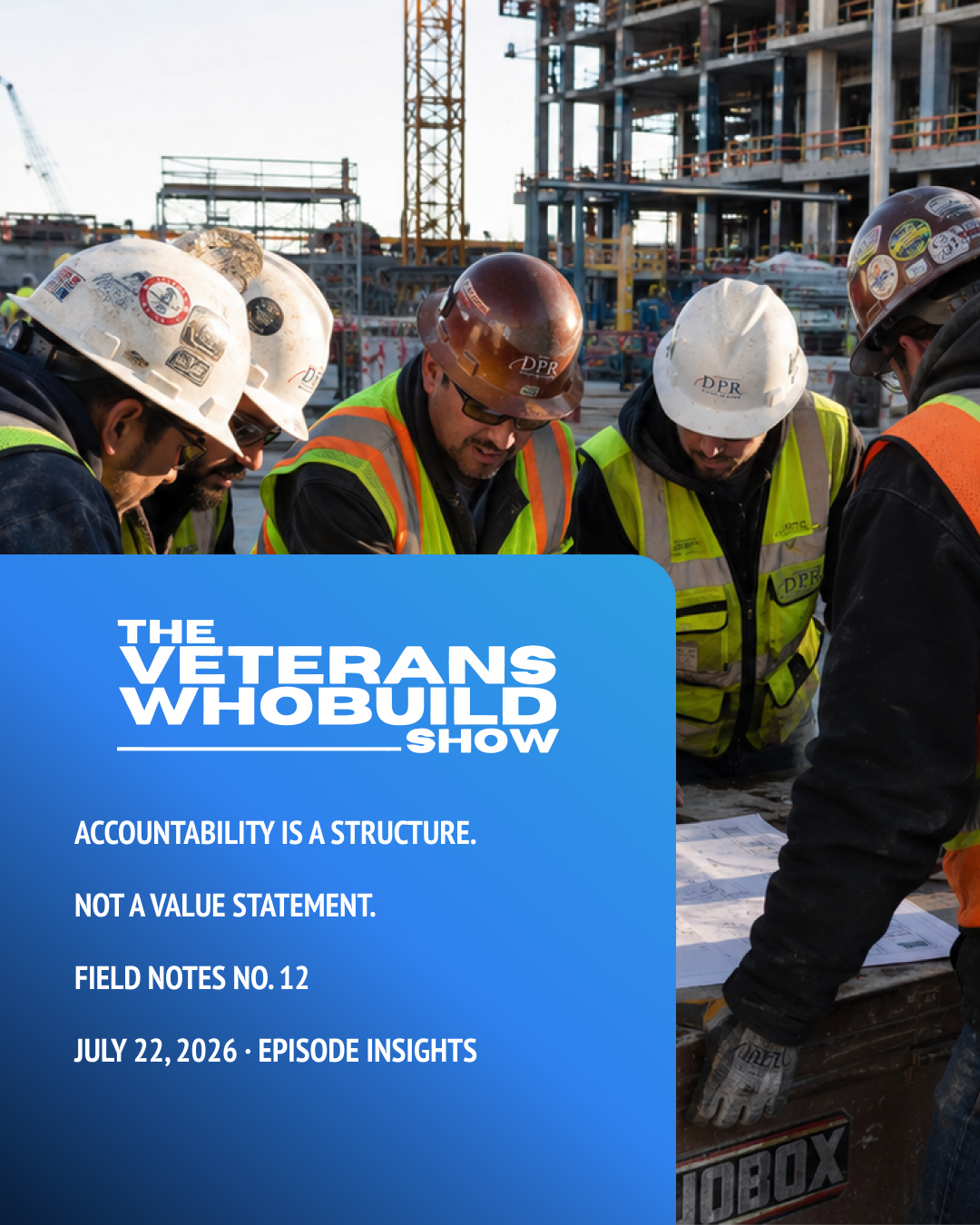
Accountability Is a Structure, Not a Value
What has to actually exist for "we hold people accountable" to be true.
By Adam Stark
Field Notes No. 12 — from The Veterans Who Build Show
Last Friday’s post ended on a line worth extending: without a system, the person is the only thing left to question. The natural follow-up is the question this entry answers — what does the system actually consist of?
Accountability isn’t a value a team decides to have. It’s three specific things, and an organization either has them or it doesn’t.
The Three Parts
An owner. A named individual responsible for a specific outcome. Not a team, not a department, not “whoever’s closest to it when it comes up.” A real accountability structure can answer, without hesitation, who owns the readiness check for a given activity, who owns the data ownership question for a given project, who owns the verification of a given handoff.
A cadence. A defined point at which the outcome gets checked. Not “whenever someone notices.” No. 04 covered this in depth — verification is a rhythm, not an act. The cadence is the mechanism that makes accountability something other than luck.
A record. Something that shows whether the outcome happened or didn’t, available after the fact. Not for blame — for pattern recognition. A record turns a single incident into data. Without it, every failure looks unprecedented, even when it’s the fourth time the same gap has produced the same result.
Most organizations have accountability as a value statement — “we hold people accountable here” — without any of these three structural components underneath it. That gap is invisible until something goes wrong. Then it becomes very visible, very fast, because there’s nothing to examine except the person closest to the failure.
Why This Isn’t the Same as No. 06
This series covered a related triad in No. 06 — information needs a what, a who, and a when to be actionable. It’s worth being precise about the difference, because the parallel is real but the object is different.
No. 06 was about information design — what makes a specific report or update capable of driving a decision. This entry is about accountability design — what makes an organization’s responsibility structure real rather than aspirational. Information can meet the No. 06 bar and still exist inside an organization that has no owner, no cadence, and no record for whether anyone acted on it. The two triads solve adjacent but distinct problems: one is about a single artifact, the other is about the system the artifact lives inside.
What Military Command Accountability Gets Right
Veterans recognize the owner-cadence-record structure because it’s how command accountability functions by design, not by aspiration.
Every outcome in a military operation has a named owner — not a unit, a person. Every readiness state has a checkpoint where it gets verified, on a schedule that’s defined in advance, not improvised under pressure. And every action of consequence gets logged. Not primarily to assign blame after the fact, but so the pattern is visible to the next commander, the next planning cycle, the next after-action review.
That logging is what makes the “what did the system miss?” conversation possible instead of theoretical. A commander reviewing an incident can look at what was supposed to happen, who owned it, and what was recorded — and from that, actually diagnose whether the failure was individual or structural. Without the record, that diagnosis is guesswork dressed up as analysis.
Where Construction’s Accountability Culture Breaks Down
Construction often has the value of accountability without the structure underneath it.
Project reviews happen. Status meetings happen. Everyone agrees that accountability matters. But ask, in the middle of a live project, who specifically owns the readiness verification for next week’s pour, on what cadence that gets checked, and what record exists showing whether it happened last time — and the answer is often vague. Multiple people are somewhat responsible. The check happens “before the pour,” which isn’t a cadence, it’s a hope. And the record, if it exists, lives in someone’s memory of a phone call.
When something goes wrong under those conditions, there’s no owner to review, no cadence that should have caught the gap, and no record to learn from. The review has nowhere to go except the individual standing closest to the failure. Blame isn’t a cultural failing in that moment — it’s the only material available.
This is the same root cause No. 10 named directly: many projects end with the owner holding the building and the GC holding the data. Without clear data ownership, none of the three accountability components — owner, cadence, record — have anywhere to attach. Data ownership isn’t a separate problem from accountability. It’s the substrate accountability is built on.
What the Teams Pulling Ahead Are Doing
Three patterns keep showing up among organizations that have built real accountability structures.
They name an owner for every recurring outcome, not just project milestones. Not “the project team” — a specific person, for a specific check, at a specific point. Ambiguity about ownership is treated as a defect to fix, not a normal condition of a busy project.
They define the cadence in advance, in writing. The verification rhythms from No. 04 are the mechanism. When the check is supposed to happen is decided before the project starts, not improvised in the moment.
They keep a record that outlives the individual project. Not for litigation — for pattern recognition. An organization that can look back across ten projects and see the same gap recurring in the same place has something no single postmortem can produce: the ability to fix the system instead of replacing the person.
That’s not a discipline problem at the individual level. It’s an infrastructure one — the same shift this series keeps returning to. Build the owner, the cadence, and the record, and the accountability conversation stops defaulting to blame, because there’s finally something else to examine.
Accountability is a structure. Not a value statement.
What’s missing at your organization — the owner, the cadence, or the record?
Field Notes No. 11 — Faith Is Not an Operational Architecture — covered what fills the gap when systems aren’t in place. No. 13 lands next Wednesday.
Produced by Adam Stark, Founder of Jet.Build and host of The Veterans Who Build Show.