Leadership & Accountability · May 6, 2026 · 2 min read
Commander's Intent
Field Notes No. 02 — from The Veterans Who Build Show
By Adam Stark
Construction often gives PMs a target — then makes them ask permission for the moves needed to hit it.
Hit the budget. Hit the schedule. Anticipate the risk before it becomes a claim. But check before you reallocate. Check before you authorize the change. Check before you make the call the moment requires.
The result is a kind of slow-motion stall. Decisions wait while outcomes tick down. By the time approval arrives, the moment that needed it has already passed.
The Principle
Military operations work differently. Leaders share something called Commander’s Intent — the mission and the why, captured in one short statement. Then they trust the team to execute within their scope.
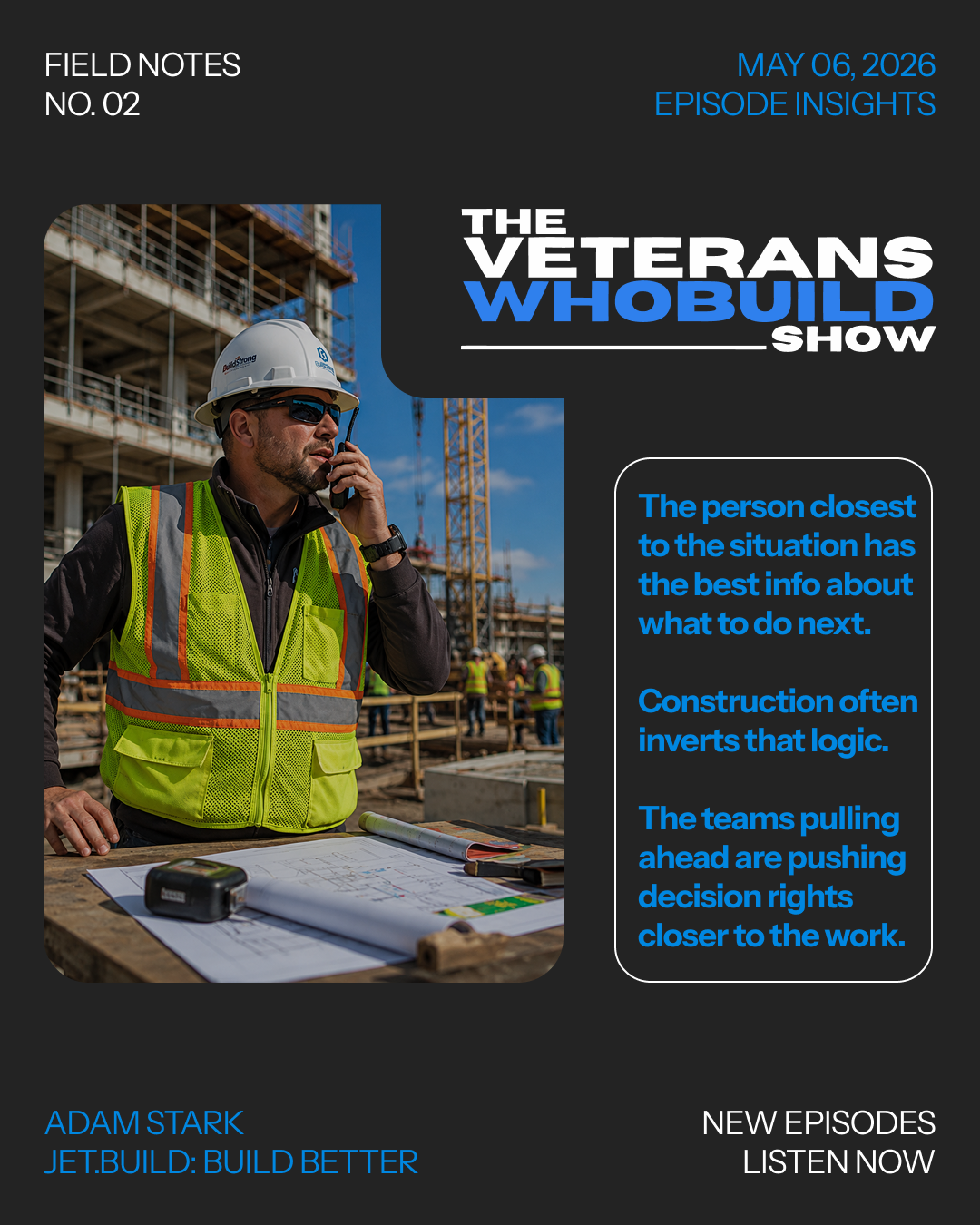
The logic underneath it is straightforward. The person closest to the situation has the best information about what to do next. So you give them the why upstream and trust them to figure out the how downstream.
That’s not a relaxation of standards. It’s the opposite. Commander’s intent works when the why is clear enough that the person on the ground can tell whether their next move serves the mission. Anything murky in the intent shows up as hesitation in the execution.
Where Construction Inverts It
The industry often runs the opposite way.
The people closest to the work are the furthest from the decision rights they need. A PM with twenty years of experience can be told to deliver a project on budget, then required to seek approval for the calls that protect that budget in real time. The authority and the accountability sit in different places.
The cost shows up in the schedule. Not because anyone made a wrong decision — but because the right decision waited. Slow approval becomes its own form of risk.
What the Teams Pulling Ahead Are Doing
Two patterns keep showing up among teams that consistently outperform.
They get clear on intent upstream so speed can show up downstream. Project objectives aren’t just budgets and dates. They include the why behind the budget and the dates — what the budget is meant to protect, what the schedule is meant to enable. When the intent is clear, decisions at the edge align without needing approval at the center.
They replace approval-by-default with intent-by-default. Not by removing oversight. By making oversight the exception rather than the rule. The PM doesn’t ask whether a $5K reallocation is permitted. They know what the project is meant to deliver, and they make the call.
That’s not a cultural shift. It’s an infrastructure one — the same shift this series keeps coming back to. Build the system that surfaces intent and pushes decision rights to where the work is, and the behavior follows.
Speed isn’t the goal. Coherent action is.
*Field Notes is a weekly series drawing patterns from conversations on The Veterans Who Build Show and observations from inside the construction industry. No. 01 — Authority Without Information — is here. No. 03 lands next week.*