Information & Decisions · July 2, 2026 · 5 min read
The Building Is Yours. The Data Isn’t.
Field Notes No. 10 — from The Veterans Who Build Show
By Adam Stark
Ten entries into this series, a pattern has become clear.
Every problem this column has named — authority without information, decision rights that don’t reach the field, readiness that doesn’t get verified, information that arrives after the window has closed, a culture that rewards the save over the system — has the same upstream cause.
The data doesn’t belong to the people who need to act on it.
That’s not a technology problem. It’s a governance one. And it’s the root that most of the construction industry’s accountability and execution failures grow from.
What the Series Has Been Circling
Field Notes No. 01 opened with a PM who’s accountable for outcomes they can’t see in real time. That problem — authority without information — has shown up in different forms in every entry since.
In No. 02, the question was commander’s intent: who has the decision rights to act, and are they close enough to the situation to act well? In No. 03, it was readiness: does the team verifying a phase transition actually have the information to verify it? In No. 05, it was the handoff: does the receiving party know what they’re inheriting before they inherit it? In No. 06, it was information design: does the output surface what, who, and when? In No. 08, it was timing: does the right information reach the right person inside the window where it can still change the outcome?
Each of those is a version of the same question. Who has the data. And whether they can act on it.
The answer in each case pointed at the same structural gap: the data architecture of construction doesn’t route information to the people who need to act on it by default. It routes it to whoever collected it first.
The Default Ownership Problem
Construction generates enormous amounts of data across a project’s life. Budgets, schedules, RFIs, submittals, change orders, daily logs, inspection records, as-builts. That data represents the operational history of the project — the decisions made, the problems encountered, the solutions applied, the outcomes produced.
By default, that data belongs to whoever collected it first.
The GC holds the project management data. The subcontractors hold their production data. The vendors hold the procurement history. The software platforms hold whatever was entered into them — and licensing terms determine who can access it, export it, or take it when the project closes.
The owner who funded the project — who has the most at stake in the outcome — often has the least access to its data. They receive reports. They attend status meetings. But the underlying data those reports summarize, and the real-time picture of how the project is actually performing, often sits in systems the owner doesn’t control and can’t query.
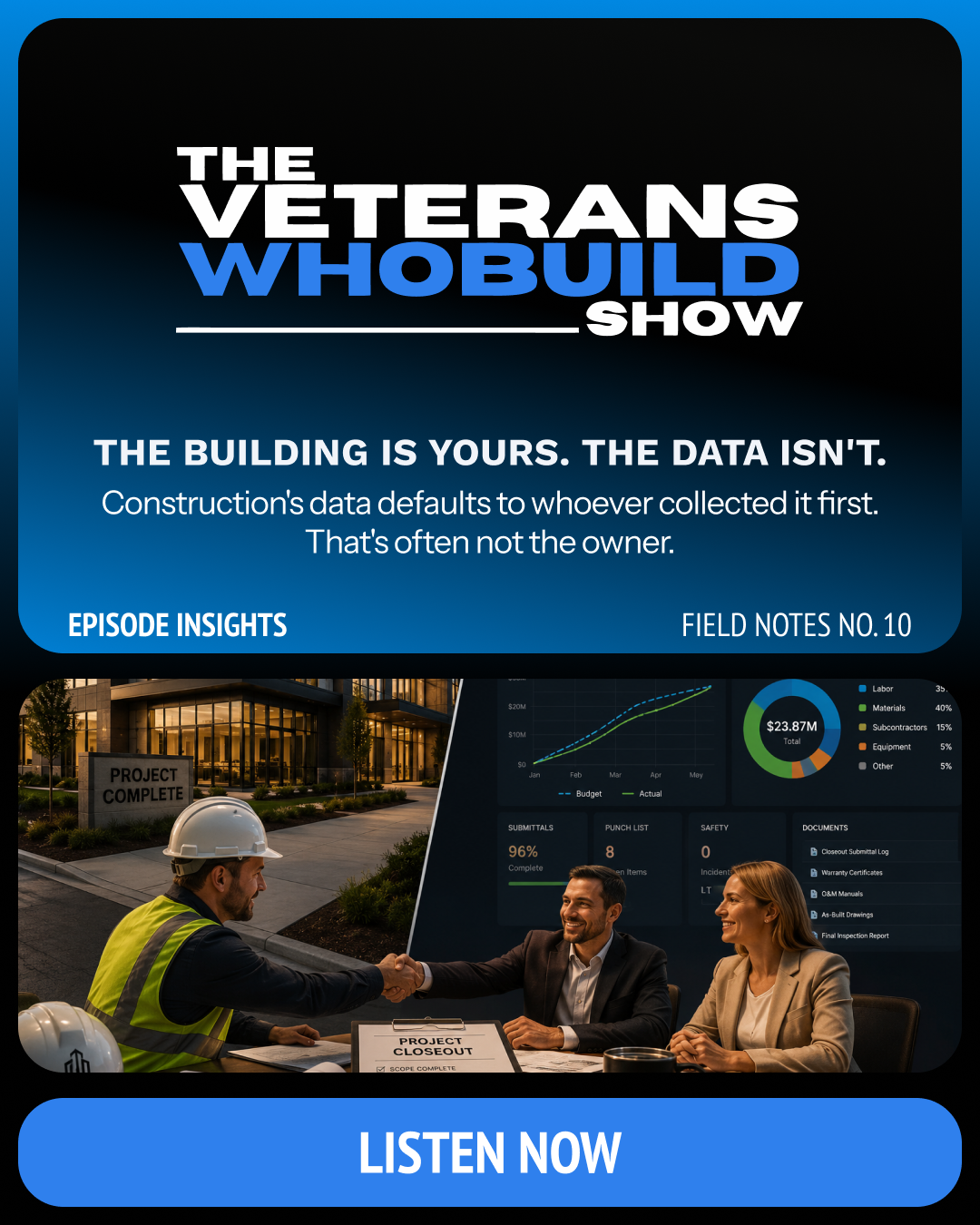
Many projects end with the owner holding the building and the GC holding the data.
That split is the structural cause of the accountability problem this series has been describing. You cannot hold someone accountable for an outcome they can’t see. And you cannot give someone visibility into a project they don’t control the data of.
What Military Operations Get Right
In military operations, information ownership is explicit by design. Not an afterthought, not a convention, not a default based on whoever happened to collect something first.
Before a mission starts, the intelligence architecture is designed. Who owns what intelligence product. Who has access to which systems. How information flows between units. What gets shared across the chain and what stays compartmentalized. These decisions are made deliberately, because the cost of getting them wrong shows up immediately in the field.
A unit that doesn’t have access to the intel it needs isn’t operating with incomplete information because the information doesn’t exist. It’s operating with incomplete information because the architecture didn’t route it correctly. The information’s existence is not the same as the information’s availability. Making it available to the right people at the right time is the actual work.
Construction has never fully made this design decision. The data architecture of most projects gets determined by the contracts, the software each party uses, and the default behavior of the tools they work inside. Nobody sits down before the project starts and designs who owns what, who can access what, and how the data flows to the people who need to act on it.
So the design happens by default. And the default tends to favor the party who collected the data, not the party accountable for the outcome.
What the Teams Pulling Ahead Are Doing
Three patterns keep showing up among owners and teams that have started closing this gap.
They define data ownership before the project starts. Not after the contract is signed, not after the first dispute, not at closeout. The data architecture — who has access to what, on what cadence, in what format — gets designed alongside the delivery structure. The owner’s data rights get specified in the contract the same way the schedule and budget do.
They distinguish between reporting and access. Receiving a report about the project is not the same as having access to the project’s data. Reports summarize and delay. Access is real-time and queryable. The teams pulling ahead are moving owners from the former to the latter — because the owner’s accountability for the project’s outcomes requires it.
They treat project data as an asset, not a byproduct. The data generated by a project has value beyond the project itself. It’s the basis for future estimates, future scheduling, future risk assessment. Owners who own their project data can learn from it. Owners who don’t receive a building and a report — and start the next project from scratch.
That’s not a technology shift. It’s a governance one — the same shift this series keeps returning to. Build the contracts and systems that define data ownership clearly, route information to the people accountable for outcomes, and the accountability problem the industry keeps describing starts to have a foundation to stand on.
Many projects end with the owner holding the building and the GC holding the data.
The teams pulling ahead are making sure that doesn’t happen before the first shovel hits the ground.
Field Notes is a weekly series drawing patterns from conversations on The Veterans Who Build Show and observations from inside the construction industry. Earlier entries are available on Substack. No. 11 lands next week.