People & Workforce · June 24, 2026 · 4 min read
The Hero Culture Tax
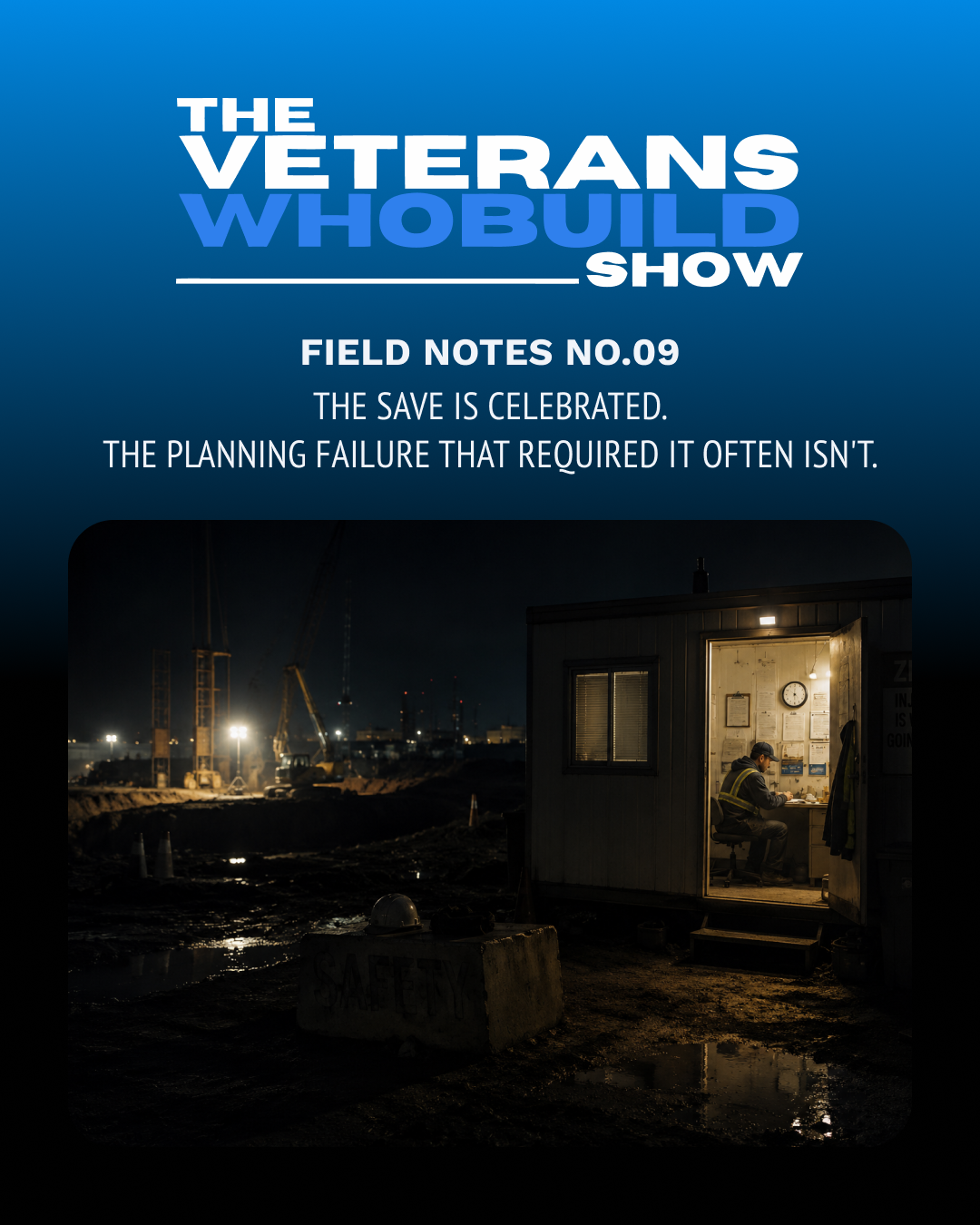
Field Notes No. 09 — from The Veterans Who Build Show
By Adam Stark
Construction has a version of success that tends to go unexamined.
The superintendent who works through the night to save the schedule. The PM who catches the critical error at the last possible moment. The crew that figures it out under pressure and delivers anyway. These moments get celebrated — in project debriefs, in performance reviews, in the stories that define a company’s culture.
The people doing that work are genuinely skilled. That part of the story is true.
What goes unexamined is the other part: what made the save necessary.
What Veterans Recognize
In military operations, improvisation under pressure is frequently read as a signal — not a success story.
A unit that had to improvise its way through a mission often didn’t have the right intelligence, the right resources, or the right coordination before contact. The after-action review asks what went wrong upstream. Not to diminish the people who performed under pressure — but because the goal is to make the next mission require less improvisation, not more.
The hero narrative, in military doctrine, has a ceiling. Individual excellence is the baseline expectation. What gets recognized — and built into subsequent planning — is execution that proceeds without requiring extraordinary individual effort. Unremarkable execution is often the goal. It means the system worked.
Construction tends to invert that logic. The save gets celebrated. The planning failure that required the save often goes unnamed.
The Reward Structure Problem
This matters more than it might seem, because what gets celebrated shapes what gets built.
When the culture recognizes heroics, people tend to optimize for heroics. The superintendent who works all night is visible. The superintendent who built the process that meant nobody needed to work all night is invisible. Both produced value. The industry tends to see one of them.
The downstream effect is predictable. Investing in systems that prevent crises doesn’t produce the moments that build reputations. Solving the problem before it’s visible doesn’t generate the narrative. And so the incentive runs away from prevention and toward recovery — not because individuals are short-sighted, but because the reward structure points that direction.
That’s the tax. It’s not paid in a single dramatic moment. It’s paid in the accumulated cost of preventable crises, the burnout of people perpetually in recovery mode, and the margin erosion that no one tracks under its real name.
The Invisible Alternative
The alternative doesn’t look dramatic. That’s the point.
A project week where every handoff completes cleanly, every activity starts with its constraints cleared, every issue surfaces inside the decision window — that week is unremarkable. Nothing went wrong. Nobody saved anything. The superintendent went home on time.
From the outside, it looks like nothing happened. From the inside, the system worked exactly as designed.
Veterans who build operations from scratch often describe this as the goal: making the exceptional routine. The debrief on a well-run mission is brief — not because there’s nothing to learn, but because execution tracked close to the plan, the contingencies that were built got used rather than invented, and the people on the ground had what they needed before they needed it.
Construction’s version of that outcome is achievable. It requires investing in the infrastructure that makes it happen — readiness verification, verification rhythms, clean handoffs, decision-grade information. All of which this series has covered. The hero culture is, in part, the cost of skipping that investment and managing the consequences instead.
What the Teams Pulling Ahead Are Doing
Three patterns keep showing up.
They design for predictability, not recovery. The effort goes upstream. What conditions would produce a crisis? How do we eliminate them before the work starts? The constraint identification happens in the lookahead, not at the moment of impact.
They measure what the system prevented, not just what it produced. Quantifying the crisis that didn’t happen is genuinely difficult. The teams doing this tend to track leading indicators — how many constraints were cleared before activities started, how often activities started on the planned date, how many handoff issues were identified before the receiving trade arrived. The absence of problems gets treated as data.
They treat the quiet week as the metric. When a project week requires no heroics — no emergency calls, no crisis management, no all-hands moments — that’s the signal the system is working. Not mediocrity. Not luck. The system doing its job.
That’s not a culture problem at the individual level. It’s an infrastructure one — the same shift this series keeps returning to. Build the system that makes crises predictable and preventable, and hero moments become rare exceptions rather than the defining rhythm of the work.
A hero moment can be a success story. It can also be evidence that the system upstream didn’t do its job.
The difference is worth examining.
Field Notes No. 08 — Being Right Too Late — covered the cost of correct decisions that arrived after the window closed. No. 10 lands next week.